
Companies are Training the People Who Need it Least
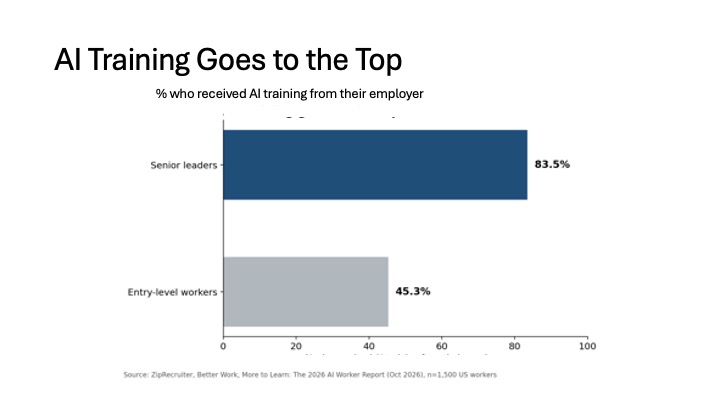
If you plan to keep up at work you will need AI skills, which is fair enough. Where you get those skills is less clear, however, since there is marked gap between the need for those skills and the training offered to get them.
The existence of an AI training gap is one thing that comes out of a new report from ZipRecruiter, released last week. Titled ‘Better Work, More to Learn: The 2026 AI Worker Report’it contains some other interesting statistics, including data that firmly shows that AI skills are going mainstream, with U.S. job postings that call for using AI were up by 159% year over year. Using AI also apparently makes work more enjoyable (52.6% of workers surveyed say it is), with the benefits rising along with with seniority in organizations.
It is more or less a happy report, with two exceptions. One is the existence of that training gap. Overall, the existence of AI means that skills are getting outdated more quickly, which in turn is causing some workers to experience ‘AI-nxiety’. Middle managers are apparently the most concerned, with 45% of this group saying they are somewhat or very worried about this, compared to only 27% of the C-Suite. Workers are willing to get training to learn AI skills, but it is apparently not that available. Over one third of those surveyed said that they had to learn entirely on their own because their employers did not provide training. Significantly, amongst entry-level workers, that figure was 54.7%. The data on who actually is getting training tells the story too: 83.5% of senior workers are getting training on AI skills vs. just 45.3% of entry level workers.
And that is the other exception to the happy story, what the use of AI means to entry level workers. According to ZipRecruiter, AI is being used to do things that entry level workers have traditionally done, tasks such as taking meeting notes, summarizing research or drafting texts. That is a story we have heard a lot lately, and although the data is mixed as to whether it means that fewer entry level workers are needed, it does certainly mean that the ones hired need different and better skills (as a previous ZipRecruiter study said ‘the bar for entry-level workers is rising’).
It all points to a labour market where the onus is increasingly on workers to figure it out themselves or fall through the cracks. That will certainly be to the disadvantage of some individuals, but if it does not get fixed it will ultimately be to the detriment of the economy as well
